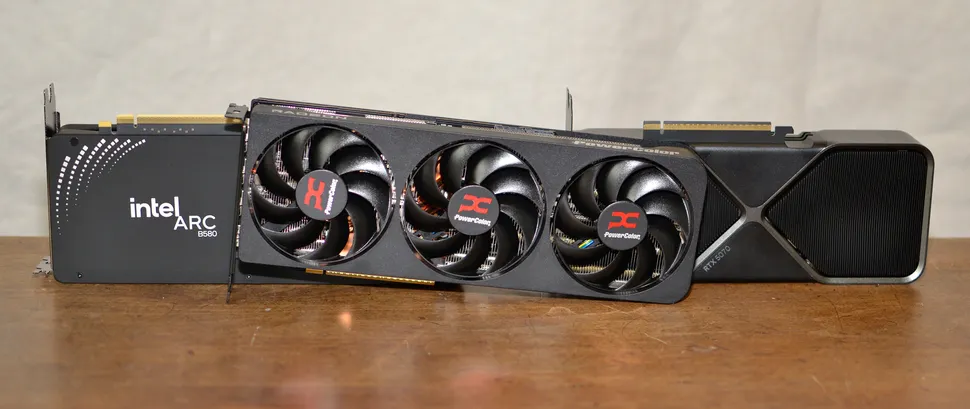
Since our last look at the best GPUs, both AMD and Nvidia have filled out their current generation product stacks even more, and we’ve reviewed all those products and given them our verdict. The RTX 5060 Ti, RTX 5060, and Radeon RX 9060 XT have all launched in their various memory configurations, and that’s made for fierce competition in the more attainable end of the graphics market.
A couple of older-gen GPUs still hang around at the very bottom of the barrel, like the Radeon RX 6600, the GeForce RTX 3050, and the Intel Arc A750, but those products are only likely to hang around until newer products take the torch from them.
We have fully refreshed our list of the best graphics cards. Given current market conditions, we’ve trimmed down the number of selections and mostly opted for the latest generation products — there’s often no sense in paying more for a slower previous-gen part. Everything is fully new for this update.
Nvidia is set to launch the RTX 5050 soon, bringing Blackwell all the way down to the $249 price point, but its early performance numbers don’t look earth-shattering. AMD hasn’t announced any plans for an RX 9050 yet, but it’s not a stretch to imagine one might be in the works. You can still grab an Arc A750 for $200 if you have no other options, but we recently revisited it and found that it’s still a somewhat compromised product.
feed
As for the rest of the market, on-shelf prices range from the usual premiums over MSRP to eye-watering markups that nobody should pay. At least you can still buy most any graphics card from stock at some price point, unlike the worst days of the crypto crunch, where shelves were totally bare and restocks created a mad rush for anything available.
Tariff uncertainty and silicon supply constraints from the AI boom haven’t eased, so outside of isolated sales, we expect these elevated prices to be the state of things for the foreseeable future. If nothing else, that stability makes it easy for us to make confident recommendations. Here goes.
Amazon Prime Day 2025 GPU Deals You Can Still Get
With Amazon Prime Day 2025 over, we’re still seeing great deals on graphics cards. We’re covering all of the processor sales on our best Prime Day GPU deals page. Here are some of our current favorites:
2. Best midrange graphics card: GeForce RTX 5070, $649.99

Unlike the marked-up RTX 5070 Ti and eye-watering RTX 5080, the RTX 5070’s prices have stayed within the ballpark of Nvidia’s MSRP. It’s easy to find one for about the same price as or less than a Radeon RX 9070 goes for right now, making AMD’s second-highest-end RDNA 4 card a harder sell than its XT sibling.
The RTX 5070 brings a strong triple threat to this price point: enough raster and ray-tracing performance at 1440p to natively push high-resolution monitors, plus Nvidia’s superior DLSS 4 upscaling and unique multi-frame generation capability. Unlike the pricey RTX 5070 Ti, we think those factors are too compelling to ignore when the RTX 5070 is pitted against the RX 9070, dollar for dollar.
If more RX 9070s sold for closer to AMD’s $549 MSRP, we’d have to give it top billing in this space. But the second-best RDNA 4 card sells for prices that are only a bit lower than the cheapest RX 9070 XT right now, so if you’re already considering a 9070, there’s really no reason to do anything but step up to one of the cheaper RX 9070 XTs out there for a relatively small premium.
By the same logic, we’d also try to stick to the cheaper end of the RTX 5070s, since the 9070 XT is 14% faster than the Nvidia middleweight. $600 RTX 5070s are a far more common sight than $600 RX 9070s, so this isn’t a hard task.
The RTX 5070’s 12GB of VRAM means it may have less longevity than the RX 9070 and its 16GB of VRAM, but if you’re not trying to push the limits with a 4K monitor or heavy ray-tracing, we think it’s an OK tradeoff for now. DLSS 4 upscaling means you can generally get away with lower internal resolutions than other upscalers, too, potentially reducing VRAM pressure even if you do want to target higher output resolutions.
If you want a solid foundation for 1440p gaming and the option to enable all of Nvidia’s DLSS 4 tech at will for a reasonable price, the RTX 5070 is the best way to get there right now.
Read: Nvidia GeForce RTX 5070 review
3. Best enthusiast GeForce RTX Blackwell card: GeForce RTX 5070 Ti, $929.99

If you want the best blend of high performance and cutting-edge graphics tech out there, the Nvidia GeForce RTX 5070 Ti is it, with full support for Nvidia’s latest DLSS 4 upscaling and Multi-Frame Generation.
AMD’s closest competitor to the RTX 5070 Ti, the Radeon RX 9070 XT, is cheaper than the RTX 5070 Ti, but the AMD card obviously doesn’t support DLSS 4. For the privilege of those capabilities, you’ll need to spend 16% more money for just 5% more performance than AMD’s current best before you turn on MFG, if that’s your thing.
We’re personally fans of MFG when it’s implemented well, and Nvidia’s DLSS 4 upscaling is superior to and much more widely adopted than the still-nascent FSR 4, so there are compelling arguments for choosing an RTX 5070 Ti over the Radeon RX 9070 XT. You’ll just need to decide whether you can stomach the upcharge.
What about the RTX 5080? Nvidia’s second-fastest Blackwell card is anywhere from 8% to 16% faster than the 5070 Ti, with the biggest gap at 4K. It sells for a whopping 50% or more over MSRP at the midpoint of current e-tail prices, where you’re most likely to find stock. That’s almost 66% more expensive than the midpoint of RTX 5070 Ti prices and a ludicrously poor value proposition.
Unless you’re seriously hurting for every last bit of horsepower you can get at 4K short of buying an RTX 5090, we can’t recommend the RTX 5080 right now.
Read: Nvidia GeForce RTX 5070 Ti review
Post a Comment